
LDS Edition
The PursuitHow It Works: Watch a topic video each week and come ready to talk with a group or mentor, using the discussion questions as a guide. Complete the track in 12 weeks or take more time to cover additional topics at the end of each section.
Q. What is discipleship?
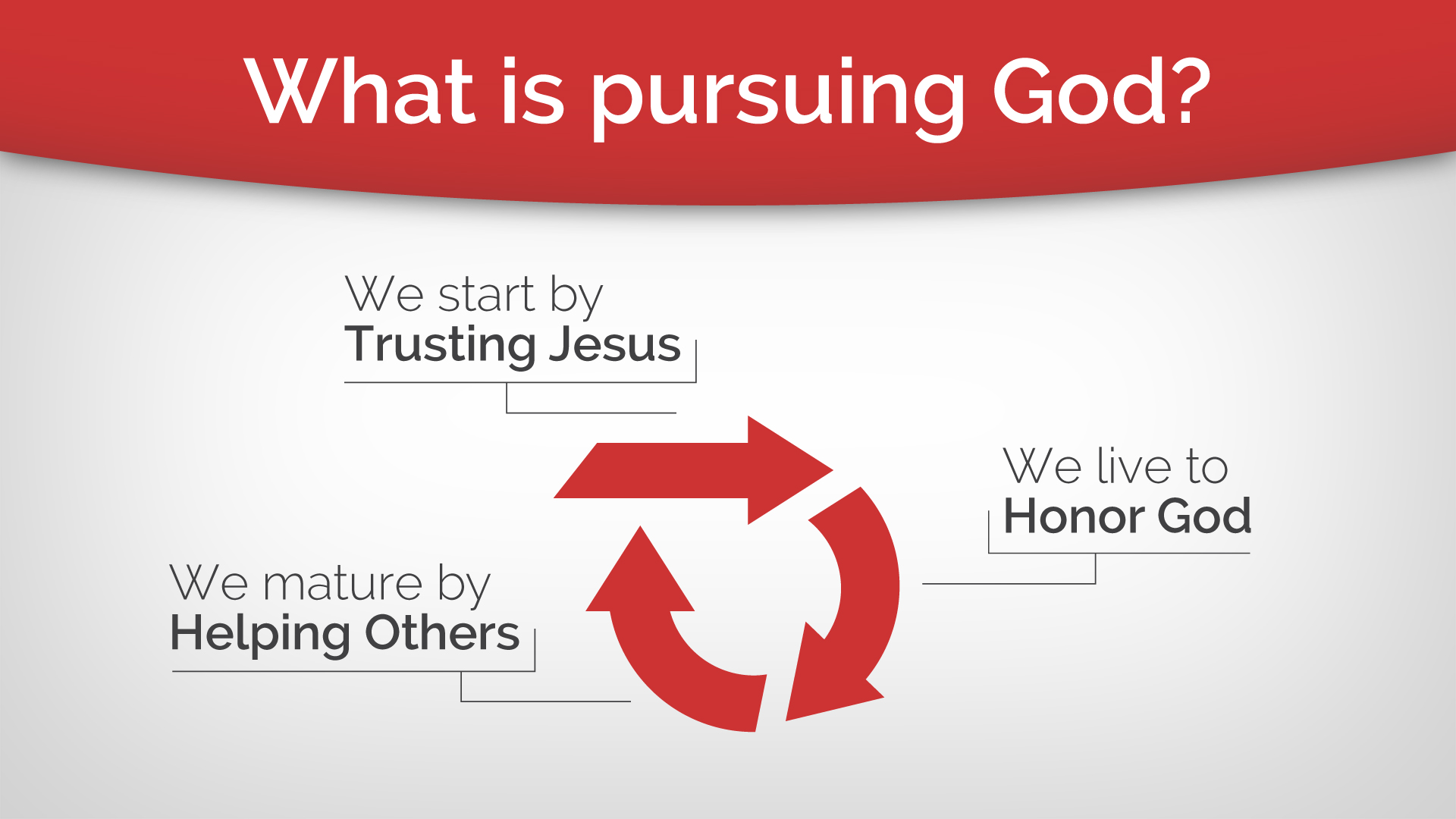
At pursueGOD, we define discipleship in terms of a simple “full circle” process that includes three key elements (see below). Discipleship tracks are designed to create a clear pathway for you to make it around the circle, featuring 12 topics on faith, life, and everything in between.
Q. How do discipleship tracks work?
Discipleship tracks are designed to help you go “full circle” with a group or mentor over the course of 12 or more weeks. Just cover a topic every week with a group or mentor, watching the video ahead of time to prepare for the conversation. Connect in person or on the phone and use the discussion questions provided to learn together.
Q. What is the structure of a discipleship track?
Discipleship tracks are divided into four sections. First you’ll get warmed up with topics we think you’ll find interesting. The next section helps you through Step 1 in a “full circle” pursuit, laying out the basics of faith and helping you trust Jesus for salvation. Next we’ll lay the groundwork for Step 2, showing you the importance of honoring God in your daily life as a Christian. The final section will help you go “full circle” and become a disciple-maker, showing you how to help someone else through this discipleship track.
Q. What if we need more than 12 weeks?
Then take more time! We recommend covering additional topics at the end of any section as needed for your own pursuit of God. For example, if you need more time to get connected before talking about faith or the Bible, cover additional topics in Section 0. If you need more time to investigate the claims of Christianity, cover additional faith topics in Section 1. If you need more time to talk about honoring God in your daily life, cover additional topics in Section 2. Slow is fast, so take your time as you work through this discipleship track.
Q. What’s next when we finish this track?
The ultimate goal is to equip you to go “full circle” and help someone else through this discipleship track. So once you’ve completed this track, join the movement and bring someone else through it! This doesn’t mean you have to stop meeting with your group or mentor. Continue to cover additional topics from one of our sites as needed.

Topic #1: The Pursuit
Key Points:
- Everyone is pursuing something that they consider ultimate, and that means everyone is pursuing a “god”.
- Before you even thought about God, he was pursuing you. Psalm 139:16-17
- If you make a decision to pursue God, you will find him. Jeremiah 29:11-13
- Pursuing God is about going “full circle,” and it involves faith (trusting Jesus), life (honoring God), and purpose (helping others).
Podcast (subscribe):
Image:
- What’s your initial reaction to this topic?
- Do you have any questions about faith or the Bible right now? Start a list.
- Make a list of areas where you would like to make improvements in your daily life.
- Read Psalm 139:17. Is this a new concept for you to realize that God uniquely created you? Explain.
- Read Jeremiah 29:11. What do you hope your life looks like in 5 or 10 years? Paint a picture.
- Where would you put yourself on the circle above? Explain.
- Is there a step you need to take based on today’s topic?
Topic #2: Rethinking Mormonism
Key Points:
- The Bible Can Be Trusted
- God Is Real Apart from Mormonism
- There Are Many Quality Church Options After Mormonism
- There Is Life After Mormonism for Families
- What’s your initial reaction to this topic?
- What are some misconceptions you have discovered in your thinking as you transition out of Mormonism?
- On a scale of 1-10, how much is your attitude toward the Bible shaped by LDS assumptions versus your own investigation? Explain.
- What difference does it make if the Bible is fully trustworthy?
- On a scale of 1-10, how much is your concept of God shaped by LDS assumptions versus your own investigation? Explain.
- Are you willing to consider that the real God might be greater than the god of Mormonism? Why or why not?
- What are your basic assumptions about other, non-LDS churches? What factors have shaped those assumptions?
- What do you want for your family from a church. Why?
- How might you go about discovering what other churches offer to support families?
- Is there a step you need to take based on today’s topic?
Topic #3: Rediscovering God
Key Points:
- When it comes to understanding the nature of God, there are many differences between Mormonism and traditional biblical Christianity.
- Believing that God was once like us takes away from who He is and the relationship that He desires to have with each one of us.
- The Bible teaches that God is not only the Creator, but also the only God that ever was and ever will be.
- The Bible tells us that we will be in God’s presence forever, which is the best gift he could have ever given to us.
- What’s your initial reaction to this topic?
- If you were LDS, what was your understanding of God?
- How do you understand God now, compared to when you were LDS?
- How does the traditional biblical view of God’s holiness contrast to the LDS idea of God’s holiness?
- How does our view of God affect our view of heaven and the life to come?
- In what ways does it change our attitude to understand who God really is?
- In what other ways does your view of God change your experience of life?

Topic #4: What Is Sin?
Key Points:
- Sin can be defined as going your own way, trusting and acting on your own opinions and feelings instead of on God’s truth. James 4:17
- The Bible teaches that every human being is infected at the core with a sinful nature. Romans 3:10-12, 23
- Sin brings brokenness into our personal lives, our culture, and the world. Romans 6:23
- What’s your initial reaction to this topic? What jumped out at you?
- How does this video define sin? How would you define it?
- On a scale of 1 (Mother Teresa) to 10 (Hitler), how bad of a “sinner” are you? How do you think someone else would rate you?
- Read James 1:14-15. Give an example of how sin is a selfish impulse. Where do you think that impulse comes from?
- Read Galatians 5:19-21. Why do you think there’s such a wide variety of sin listed there? What would you add to the list?
- How have you seen sin derail your life or that of someone you know?
- For next week, take an honest look at your own life and identify a few areas of brokenness that you need to address.
Topic #5: Who Is Jesus?
Key Points:
- Jesus is both fully God and fully man. John 1:1
- Jesus lived a sinless life and yet died a criminal’s death on a cross. Isaiah 53:4-6
- The fundamental fact of the Christian faith is that Jesus died on a cross and rose from the dead. 1 Corinthians 15:3-4
- What’s your initial reaction to this topic?
- What, if anything, did you learn about Jesus when you were younger?
- Read John 1:1. Why is it important to believe that Jesus is fully God? How would it impact Christianity if he were something less?
- Read Isaiah 53:5-8. How did Jesus fulfill this prophecy? Why did he have to do it?
- Read 1 Corinthians 15:3-4. Why is it important that Jesus rose from the dead? How would it impact the basic Christian message if he didn’t?
- Spend some time investigating the claims of Jesus (see below) before next week’s meeting.
Topic #6: Trusting Jesus
Key Points:
- Every human being has a basic problem that keeps them from a rich and satisfying life. John 10:10
- Jesus fixed the human problem through his death and resurrection. Romans 5:8
- Your relationship with God begins when you personally trust Jesus for salvation. Romans 3:22
A Sinner’s Prayer:
“Jesus, I recognize I’m a sinner. I know that you died on the cross and rose from the dead so that I could have life. I’m turning from my sin now, and I’m turning to you in faith. I trust in you alone to forgive my sin and give me new life. Thank you for this free gift. Amen.”
- What’s your initial reaction to this topic?
- Review the definition of sin from the first topic in this track. Why is it important to understand what sin is? Do you agree everyone has a sin problem? Explain.
- Read Romans 6:23. Make a list of the ways sin can bring “death” into our lives.
- In your own words, explain how the death and resurrection of Jesus fixes our sin problem.
- Read Romans 3:22. Do you believe that anyone can be made right with God by trusting in Jesus? Are there any exceptions?
- Have you put your faith in Jesus for salvation? If so, when? If not, are you ready to do it today? See the “Sinner’s Prayer” above.

Topic #7: Honoring God
Key Points:
- The Spirit leads from the inside out, empowering us to honor God every day. Ezekiel 36:26-27
- The Bible guides us and shows us the attitudes and actions that honor God. 2 Timothy 3:16-17
- Other believers help us stay on the right track, both one-on-one and in the local church. Galatians 6:1-2
- What’s your initial reaction to this topic?
- Read Ezekiel 36:26. Describe the difference between a “stony” heart and a “tender” heart.
- Read 2 Timothy 3:16. What does this verse say that scripture does for us? Share a scripture verse that has been “useful” for you.
- Share a teaching from the Bible that surprised you when you first heard it. Did you obey it? Why or why not?
- Read Galatians 6:1-2. Share a time when another believer helped you on to the right path.
- Make a commitment to start reading the Bible every day. Need help? Try a reading plan.
Topic #8: The Battle
Key Points:
- There’s a daily battle between our old nature and our new nature. Galatians 5:16-17
- The freedom we have in Christ is intended to help us love people more, not just live for ourselves. Galatians 5:13-14
- The Holy Spirit produces relationship-building fruit in our lives. Galatians 5:22-23
- We participate with God by actively walking “by the Spirit” on a daily basis. Galatians 5:24-25
- What’s your initial reaction to this topic?
- Give an example of how some people misunderstand the freedom we have in Christ.
- Read Galatians 5:16-17. Share about a time when you were not “free to carry out your good intentions”.
- Read Galatians 5:22-23. Which of these is your strongest fruit right now? Which is your weakest?
- Name one or two things that haven’t changed in your life, even though you know they should have. Why has it been difficult to change those things?
- Make a list of some practical disciplines you can develop to help you walk “by the Spirit”.
Topic #9: How to Pray
Key Points:
- Pray to grow close to your father, like you’re in an actual relationship with him. Matthew 6:9
- Pray to get in step with your king – for his will to be done and not yours. Matthew 6:10
- Pray to lean on your provider because you need what only he can offer. Matthew 6:11-13
- What’s your initial reaction to this topic?
- Do you ever feel like prayer is complicated? Explain.
- Share a time when God answered one of your prayers. What did that answer tell you about God?
- Read Matthew 6:7-8. What would you say is the essence of “Gentile” or pagan prayer? How is Christian prayer different?
- When you pray “Your will be done,” what are you actually saying to God?
- Read Matthew 6:11-12. If God already knows our needs, why pray for daily food?
- Read Matthew 6:13. What inner battles – spiritual, mental, or emotional – do you face on a regular basis? How can prayer prepare you for those battles?
- Is there a step you need to take based on today’s topic?

Topic #10: Helping Others
Key Points:
- Jesus wants his followers to go “full circle” and help others pursue God. Matthew 28:19-20
- Christian maturity comes after we start discipling someone, not before. Ephesians 4:12-13
- The greatest thing you can do in your life is to help someone pursue God. 2 Timothy 2:2
- What’s your initial reaction to this topic?
- Who is helping you pursue God? How are they doing it?
- Define “full circle” faith in your own words. Where are you on the circle?
- How do most churches define “spiritual maturity”? How does this video define it?
- Do you think you can help someone else pursue God? Why or why not?
- Is there a step you need to take based on today’s topic?
Topic #11: The Process
Key Steps:
- Disciple-making is simply a series of conversations, and our discipleship tracks provide a pathway for full circle faith.
- Invite, invest, and empower to help people discover truth one conversation at a time.
- God makes the seed of truth grow in the heart and mind of the seeker. 1 Corinthians 3:7
- What’s your initial reaction to this topic?
- Who first shared their faith with you? How did they go about it, and why was it helpful to you?
- Do you find sharing your faith difficult? Why or why not?
- Invite, Invest, Empower – which one seems the most difficult to you? Explain.
- Read 1 Corinthians 3:7. How do you see this principle at work in your own story of faith?
- Do you feel qualified to make disciples? If not, what would qualify you?
- Make a list of a few people who might be interested in going through this track with you. Begin praying for those people.
Topic #12: Next Steps
Next Steps:
- Cover more training topics (below).
- Practice with the topics in this discipleship track.
- Pray for God to open a door for disciple-making.
- Follow up with your trainer after you’ve started discipling.
- What’s your initial reaction to this topic?
- Who in your life can you invite into a discipling relationship? Which discipleship track would be best for them?
- Read John 15:16. Do you think the disciples would have ever mobilized if Jesus hadn’t been so direct about it? Explain.
- Imagine that you’re discipling someone a year from now. What does your follow up relationship look like with your trainer? How often are you still connecting?
- What are some roadblocks that might keep you from helping someone pursue God? How can you eliminate those roadblocks?
- What are some training topics (see toggle below) that you’d like to cover with your mentor?
Just Finished?
We love it when someone finishes a discipleship track. Tell us about it so we can celebrate with you!
Recent Topics
Here’s what’s new on our site this week. Click here for all topics.
[post-carousel-pro id=”80823″]Featured Series
Try one of these with a group or mentor. Click here for all series.
[post-carousel-pro id=”80475″]


